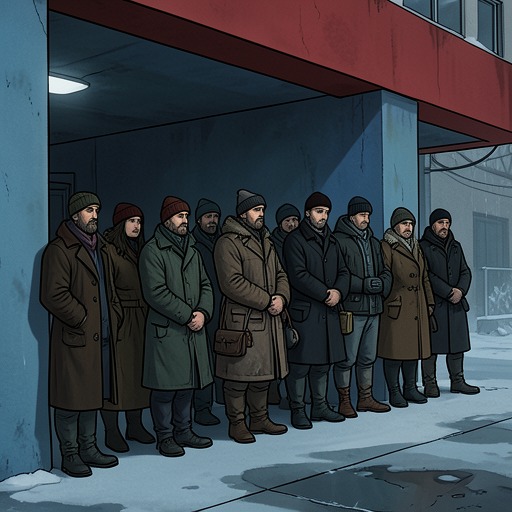
K. William Hodges
Mr. MercedesK. William Hodges is a decorated former police detective whose retirement leaves him vulnerable to isolation and a sense of unfinished business. A letter from the Mercedes Killer turns his attention back toward the mass-casualty case and gives him a renewed purpose: first as an investigator acting beyond his former authority, then as a private detective. His arc is marked by a collision between professional habits, personal risk, and the uncertain boundary between lawful procedure and private pursuit.
Identity and Life After Retirement
Hodges’s retirement is six months old when the killer addresses him by his former title, Detective Hodges, and argues that a distinguished officer deserves to keep it. The letter’s formal address recognizes both Hodges’s reputation and the identity he has left behind. At home, however, his routine is markedly smaller: he sits in his La-Z-Boy with a beer, turns on Channel Seven, and watches a show he has followed on most weekdays since leaving the police force. His Smith & Wesson .38, which belonged to his father, rests beside him; he pats it absently before settling in to watch television.
The letter interrupts this settled routine. Hodges studies its postmark and understands that the sender wants him to know he is nearby. He also recognizes that the letter is designed as a taunt, not simply a communication. After holding it for several minutes, he concludes that submitting it for forensic examination would be futile: the writer has taken care not to leave fingerprints that could identify him. Hodges’s response is characteristic of a detective’s close attention to details, but it also exposes the limits of what he can establish from the letter alone.
Investigative Habits and Judgment
The letter reactivates a method Hodges has practiced many times. He recalls tearing down threatening letters with Pete Huntley and earlier partners, sorting through communications that included threats, extortion, blackmail, a kidnapper’s ransom demand, and letters from people claiming to be murderers. Some claims had been fantasies; another might or might not have come from the serial killer known as Turnpike Joe. That history gives him a working framework for the new correspondent’s claims, but it does not resolve the central problem: whether this writer is telling the truth or inventing a story.
Hodges tests the letter against details that might distinguish knowledge from bluff. He considers the writer’s account of a condom and the way the Mercedes’s seat belt locked and the car bounced as it struck people. Those details, he reasons, would not have appeared in newspaper coverage, yet they could still have been fabricated. His established investigative skepticism therefore cuts both ways: he is alert to information that may be evidence, but refuses to treat specificity as proof.
The killer’s interest in death also reaches Hodges personally. The letter suggests that Hodges should take his own life, and he wonders whether the sender could have seen him handling his father’s revolver or putting it in his mouth. He admits that he has not thought to close the shades, leaving open the possibility that someone could observe him from outside. He considers whether Jerome might have seen him, but judges that Jerome would have been frightened and would have said something. The possibility sharpens Hodges’s awareness of his vulnerability without establishing who, if anyone, has watched him.
A Return to Purpose
Hodges knows that investigating the letter is police business, although he is no longer a police officer. When he pursues the possibility that Olivia Trelawney’s personal papers might contain correspondence from the killer, he recognizes that he is exceeding legal limits and withholding evidence. He nevertheless continues. The taunting letter has angered him, but that anger is also useful: after months without direction, the investigation gives him a reason to act. He tells himself that if he makes progress, he will turn the whole matter over to Pete Huntley, a thought that preserves a connection to his former partner even as Hodges proceeds on his own.
The prospect of paid work makes the return more tangible. Janelle Patterson offers him five thousand dollars a week for at least eight weeks, plus expenses, to investigate her sister’s death. Hodges briefly imagines the conventions of a classic private detective: a cheap office, a tough-talking receptionist, a trench coat, and a brown fedora. He recognizes the fantasy as ridiculous, but the real attraction is not the costume. It is the chance to stop sitting at home and to take up work he believes remains unfinished. The cases still occupying his former colleagues do not seem to him to be the central challenge; the Mercedes Killer does.
Private Detective and Continuing Danger
Hodges’s transition into private investigation takes visible form in his changed circumstances. At dinner with Jerome Robinson and Janelle Patterson at DeMasio’s Italian Ristorante, he wears a suit that fits better after he has lost a few pounds. Janelle has bought him a brown fedora, completing the image she associates with a private detective. Yet beneath this theatrical detail he wears a Glock at his hip, a practical sign that the investigation has brought danger into his new professional life.
That danger becomes explicit when Hodges is questioned in Interrogation Room 4, this time on the other side of the table from Pete Huntley and Pete’s new partner. His car has been blown up, and a woman has been killed. Pete asks whether the Mercedes Killer is responsible, pointing to the victim’s connection to Olivia Trelawney. For Hodges, the victim is not an abstraction in a case file: she was his lover, brought him laughter and comfort, and became a partner in the investigation. The scene reverses his former position as the detective conducting an interrogation. He is now a witness and a person exposed to the consequences of the case he chose to pursue.
Character and Narrative Role
Hodges’s return to investigative life depends on the very habits retirement had left without an outlet: remembering prior cases, examining small inconsistencies, and withholding judgment until details can be tested. The letter gives those habits a new object and renews his sense of purpose, but it cannot guarantee that his suspicions are correct or that his actions remain within the law. The gap between his former authority and his present independence is central to his role: he thinks like a detective, but must act without the institutional position and partnership that once accompanied the work.
The novel also frames his renewed identity through familiar detective conventions. Hodges imagines the fedora and trench coat, and Janelle gives him the hat; these touches both acknowledge the private-eye tradition and distinguish its performance from the real costs of investigation. A man who begins the evidence seated alone beside an old revolver ends up investigating as a private detective, armed and entangled in a case that places him under suspicion and brings personal loss into its reach. His renewed purpose is therefore neither a simple escape from retirement nor a safe return to his old profession: it draws him into a conflict where the detective’s work and his private life can no longer be kept apart.